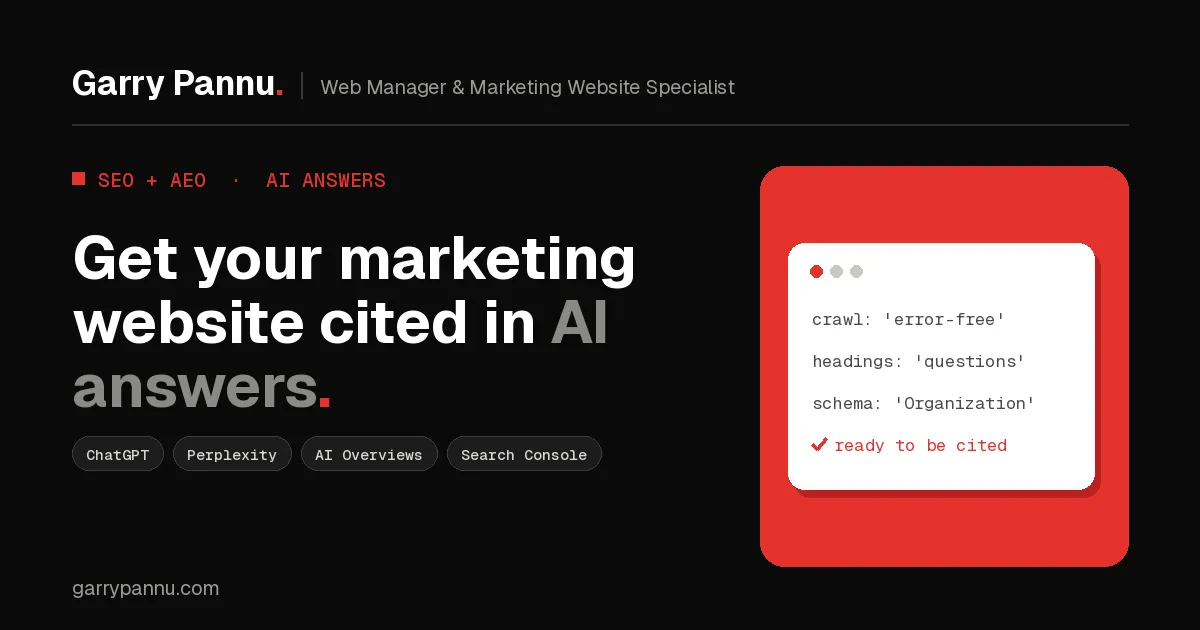
A few years ago, the goal was simple: rank on page one. Today a growing share of your buyers ask ChatGPT, Perplexity or Google's AI Overviews instead, and get a single answer. If your website isn't one of the sources behind that answer, you're invisible in that moment.
The good news: the things that make a site easy for AI to cite are mostly the same things that make it a good website. Clear structure, clean technical setup, and content that actually answers questions.
What AEO actually means
Answer Engine Optimization (AEO) is the practice of making your content easy for AI systems to find, understand and quote. It sits on top of SEO, not instead of it. If Google can't crawl your site properly, AI tools usually can't either.
If your website can't be crawled cleanly, it can't be cited. AEO starts with the technical basics.
Fix the technical basics first
Before writing a single new page, open Google Search Console and check the Pages report. Every error there is a page an AI crawler may also be skipping.
- Indexing errors: pages blocked by robots.txt, noindex tags or redirects that loop.
- Core Web Vitals: slow pages get crawled less often.
- Duplicate content: missing canonical tags split your authority across URLs.
Structure content as answers
AI tools pull short, self-contained passages. Write each section so it could stand on its own:
- Use the question as the heading.
- Answer it in the first one or two sentences.
- Add detail, examples and steps underneath.
Add structured data
Schema markup tells machines exactly what a page is about. For most marketing sites, start with an Organization block:
{
  "@context": "https://schema.org",
  "@type": "Organization",
  "name": "Your Company",
  "url": "https://yourdomain.com"
}
The takeaway
Clean technical setup, clear answers, structured data and proper tracking. Do those four things and your website is ready for search, whether the searcher is a person or an AI.

Written by
Garry Pannu
I design, build and manage marketing websites for SaaS, fintech, healthcare and IT companies, keeping them error-free, search-ready and properly tracked.